
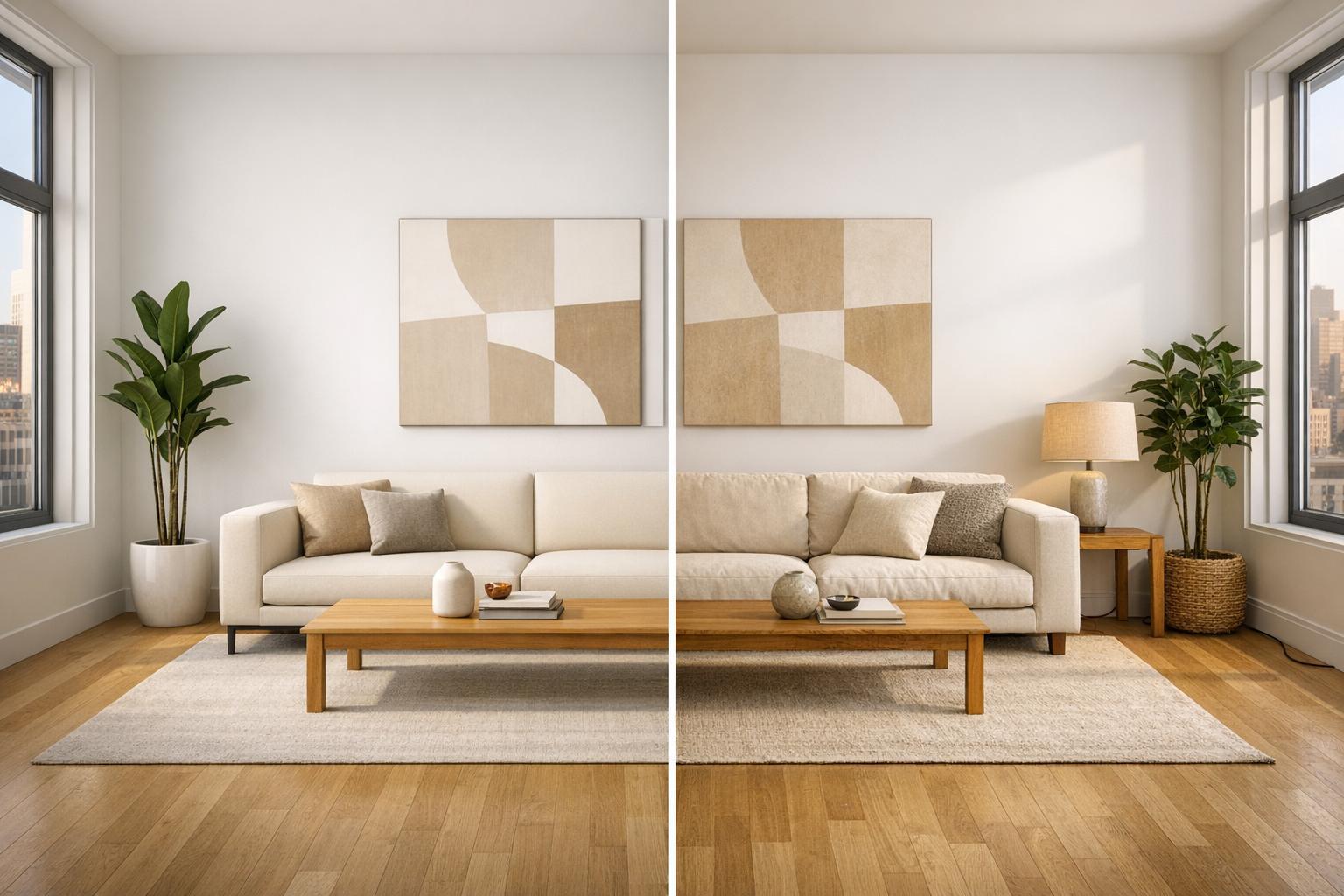
Selling a property? Staging can make or break your sale. Homes with staging sell 73% faster and for 1%-10% more. But how much should you spend?
Here’s the deal:
- Traditional staging costs $1,500–$5,000+ per property, with ongoing furniture rental fees ($500–$600 per room/month). Setup takes 1–2 weeks.
- Virtual staging is 90%-97% cheaper, starting at $1–$10 per image. AI tools deliver results in seconds or up to 48 hours.
Which one is right for you? Virtual staging is ideal for tight budgets, fast turnarounds, and online listings. Traditional staging works for high-end properties or in-person showings.
Quick Comparison
| Feature | Traditional Staging | Virtual Staging |
|---|---|---|
| Cost | $2,000–$5,000+ | $1–$39 per image |
| Turnaround Time | 1–2 weeks | Seconds to 48 hours |
| Recurring Fees | Yes (monthly rentals) | No |
| Customization | Limited | Unlimited styles |
| Best For | In-person showings | Online listings |
Virtual staging offers a low-cost, fast solution for showcasing properties online, while traditional options are better suited for physical showings. You can also see virtual staging before and after examples to visualize the impact. Keep reading for a detailed breakdown.

Virtual vs Traditional Staging Cost Comparison Infographic
Why Full Staging is a WASTE of Money!
Traditional Staging: What It Costs
Traditional staging involves physically furnishing a property to create an inviting atmosphere for potential buyers during in-person showings. Unlike AI virtual staging options, this process requires actual furniture, professional crews, and ongoing upkeep while the property is listed.
It’s a hands-on, logistics-heavy process. Staging companies handle everything from furniture delivery and room arrangements to eventual removal once the property is sold. Contracts often include a minimum rental period - typically 30, 60, or 90 days - regardless of how quickly the home sells.
"Due to its complexity and the resources required, professional staging can be costly."
– Texas Real Estate Source
Traditional Staging Cost Breakdown
Costs for traditional staging vary based on factors like property size, location, and the scope of work. Here’s a breakdown of what you might spend:
| Cost Component | Estimated Price Range | Frequency |
|---|---|---|
| Design Consultation | $300 – $600 | One-time |
| Furniture Rental | $500 – $600 per room | Monthly |
| Logistics (Delivery/Setup/Removal) | $1,000 – $2,000 | One-time |
| Total (Standard Home) | $1,500 – $6,000 | Per project |
| Luxury Property Staging | $10,000 – $25,000+ | Per project |
Initial consultations usually cost between $300 and $600, though some stagers charge hourly rates ranging from $25 to $125. The largest ongoing expense is furniture rental, which typically runs $500 to $600 per room, per month. If you opt for DIY rentals, costs drop to $100 to $300 per room monthly, but you’ll need to manage the setup yourself.
Labor and logistics - including movers, setup, and removal - add another $1,000 to $2,000 to the total. For vacant homes, pricing may be based on square footage, costing $3 to $5 per square foot. For instance, staging a 2,500-square-foot home could range from $7,500 to $12,500.
Additional services, such as cleaning, repairs, or lighting upgrades, can drive costs higher. On average, homeowners spend between $1,500 and $10,000 per property, while luxury homes often exceed $10,000, with some projects reaching significantly higher amounts.
"A thoughtfully-staged home can often sell faster and at a higher price, making it a valuable tool in the real estate market."
– Kelly Waterman, Luxury Staging Pro
What Affects Traditional Staging Prices
Several factors influence the cost of traditional staging:
- Property Size: Larger homes require more furniture and labor, increasing costs. A small condo is far less expensive to stage than a sprawling 3,500-square-foot house.
- Location: High-cost markets like New York City, Miami, or San Francisco come with higher staging premiums compared to smaller cities.
- Staging Duration: Monthly rental fees add up the longer your property stays on the market. After the initial contract, renewal fees typically range from $300 to $2,000 per month.
- Property Condition: Homes needing repairs, painting, or deep cleaning beforehand will incur extra costs.
- Market Demand: Rates often rise during peak selling seasons, such as spring and summer, due to increased demand for staging services.
- Vacancy Status: Staging vacant homes is pricier since all furnishings must be rented, unlike occupied homes where existing furniture can be used alongside rentals.
"Staging a 2,000-square-foot home would cost around $2,000 to $2,400 a month."
– Crystal Leigh Hemphill, Real Estate Professional
This detailed cost breakdown provides a clear understanding of traditional staging expenses, setting the stage for how virtual staging compares.
Virtual Staging: How Much It Costs
Virtual staging uses AI to digitally furnish and decorate photos of empty rooms. Instead of dealing with the hassle and expense of renting physical furniture or hiring movers, you simply upload a photo and receive a digitally staged image. This process helps potential buyers visualize a room's purpose and layout without requiring any physical setup.
AI analyzes the room's dimensions, lighting, and architectural details to create realistic furniture arrangements that match the space's perspective and shadows. You can instantly explore various styles - like Scandinavian, Industrial, or Farmhouse - without the need for additional labor or costs. This streamlined process eliminates logistical headaches and significantly reduces expenses.
"Virtual staging has dropped the entry cost of professional real estate marketing from thousands to less than thirty dollars per photo."
– Jovan Panetie, Co-Founder, StagingPulse
Virtual staging is priced in a straightforward way, typically billed per image or through a subscription plan. AI-based staging costs range from $0.24 to $10 per image, while manual digital staging can cost between $15 and $75 per image. For highly detailed custom work, prices can exceed $75 to $150 per image. Even at the higher end, this represents massive savings - up to 97% - compared to traditional physical staging. These cost-effective methods allow sellers to enhance their property listings while staying on budget.
InstantInterior AI Pricing Plans

InstantInterior AI offers affordable subscription plans tailored to different needs. Each plan includes commercial usage rights and ultra-high-resolution images, making it easy to integrate into professional marketing efforts:
| Plan | Monthly Price | Renders Included | Cost Per Render | Best For |
|---|---|---|---|---|
| Hobby | $13.50 | 100 renders | $0.135 | Individual agents or homeowners |
| Premium | $28.50 | 600 renders | $0.047 | Active agents with multiple listings |
| Business | $49.50 | 2,000 renders | $0.024 | High-volume brokerages and teams |
All plans include features like style customization, furniture placement, design editing, and options to digitally repaint walls or empty rooms. Higher-tier plans offer priority support and lower per-render costs, making them ideal for users with larger staging needs.
What Affects Virtual Staging Prices
Several factors influence the cost of virtual staging:
- Number of renders required: Each image, including multiple angles of the same room, is billed separately. Most listings need 8 to 12 images to effectively showcase key areas.
- Customization needs: Basic furniture placement is included in standard rates, but additional edits - like removing existing furniture, changing flooring, or altering wall colors - may require a higher-tier plan or extra fees. Rush orders for manual adjustments can add $10 to $50 per room, although AI tools typically deliver instant results.
- Subscription plan: For high-volume users, business-level plans can lower the per-render cost to under $0.03, making it affordable to stage entire property portfolios. Unlike traditional staging, virtual staging offers consistent pricing, regardless of how long a property stays on the market.
Cost Comparison: Virtual vs Traditional Staging
The price difference between virtual and traditional staging is striking. Traditional staging typically costs thousands of dollars, while virtual staging is priced in the hundreds, representing savings of 90% to 97%.
Traditional staging comes with a price tag of $2,000–$5,000 or more and requires 1 to 2 weeks to coordinate with movers and designers. On the other hand, virtual staging achieves comparable results in just seconds (AI-powered) or up to 48 hours (manual), all at a fraction of the cost.
"Traditional staging remains a premium, high-logistics service. Virtual staging, by contrast, is cheaper than a cup of coffee per photo." – StageVirtually
While traditional staging can deliver a return on investment (ROI) of 8% to 10%, the upfront costs are steep and recurring expenses can add up. Virtual staging, however, not only offers significant cost savings but also helps listings sell faster and at higher prices. Plus, with traditional staging, extended market time often means additional rental fees, whereas virtual staging is a one-time, fixed expense.
Side-by-Side Cost and ROI Comparison
| Metric | Traditional Staging | Virtual Staging |
|---|---|---|
| Cost per Room | ~$500–$600/month | ~$1–$39 per image |
| Total Cost (10 Photos/Rooms) | ~$2,000–$5,000+ | ~$15–$400 |
| Turnaround Time | 1–2 weeks | Seconds (AI) to 48 hours |
| ROI / Savings | 8–10% on sale price | 90–97% cost savings |
| Flexibility | One fixed design style | Unlimited styles, instant revisions |
| Logistics | Physical movers, setup, removal | Digital-only; no physical labor |
These numbers highlight the financial and logistical advantages of virtual staging, making it an appealing option for cost-conscious sellers and agents.
sbb-itb-4214aae
When Virtual Staging Saves You More Money
Virtual staging can be a game-changer when it comes to saving money, especially in situations where traditional staging costs quickly add up. For example, vacant properties often struggle to make an impression on buyers, as empty rooms make it difficult to visualize layouts and dimensions. Virtual staging eliminates this issue at a fraction of the cost - starting as low as $1 per image. This is particularly advantageous in competitive markets.
Speed is another major benefit. While traditional staging can take one to two weeks for consultations and setup, AI-powered virtual staging tools can produce realistic images in seconds. Take the case of a Manchester-based estate agency in January 2026: they virtually staged ten new-build flats for just $78 total (about $1.30 per photo). The listings were live within 24 hours, doubling their portal views. Within 10 days, five of the flats were reserved.
For real estate agents juggling multiple properties, the cost difference becomes even more pronounced. Traditional staging costs can range from $1,500 to $4,000 per month per property, which adds up quickly. On the other hand, virtual staging subscriptions like InstantInterior AI’s Business plan cost just $49.50 per month and allow up to 2,000 renders. This makes the per-listing cost almost negligible. In 2025, Lisa, an agent from Charlotte, NC, staged eight rooms for only $2.16. Her $425,000 listing, which had been on the market for 45 days with no offers, saw a 40% increase in online views after the update. The property sold just 11 days later for $431,000 - $6,000 over asking price.
Long-term listings also highlight the financial benefits of virtual staging. Traditional staging often comes with recurring rental fees of $500 to $600 per room per month. In contrast, virtual staging is a one-time expense. This makes it especially appealing for lower-priced homes, where spending thousands on staging isn’t practical. With virtual staging, professional-quality results can be achieved for under $100.
Whether it’s the speed, affordability, or flexibility, virtual staging proves to be a cost-effective solution in a variety of scenarios.
Why InstantInterior AI Delivers the Best Value
InstantInterior AI eliminates the hefty costs and delays tied to traditional staging by offering photorealistic 4K renders in just 30 seconds per image. Compare that to the one-to-two-week turnaround typical of traditional staging, and the time savings alone are game-changing. Their Business plan, priced at $49.50 per month, includes 24,000 credits upfront - enough to create 2,000 renders. This means you can stage entire property portfolios without worrying about extra fees for individual images or revisions. The combination of affordability, speed, and high-quality output makes this platform a standout choice.
With access to over 50 design styles - ranging from modern and Scandinavian to farmhouse and industrial - you can easily customize spaces to appeal to different buyer demographics. This flexibility goes far beyond what traditional staging can offer, which is often limited by the available furniture inventory.
The cost savings don’t stop there. InstantInterior AI also includes advanced staging tools like 360° virtual tours, AI-generated walkthrough videos, and commercial usage rights with its Pro and Business plans. This means your images are ready for MLS listings, marketing brochures, and social media - completely watermark-free and without legal restrictions.
"Staging companies are the first real estate segment entirely replaced by AI. The economics make it impossible to justify $3,000/month when $5 does the same job for online photos."
– Andrew Jeffery, Real Estate Expert
Staging has a proven impact on sales: homes that are staged spend 73% less time on the market and 85% sell for 5–23% above their listing price. With InstantInterior AI, you’re getting professional-grade results that attract serious buyers - all at a fraction of the cost of traditional methods.
For real estate teams managing multiple properties, the platform offers seamless scalability. Unlike traditional staging, which involves coordinating movers, designers, and furniture rentals - often costing hundreds of dollars per property - InstantInterior AI simplifies the process. Just upload your photos, choose your design styles, and you’re done. No physical logistics, no scheduling headaches, and no recurring rental fees. It’s a straightforward, scalable, and budget-friendly solution for both real estate professionals and homeowners.
Conclusion
The numbers speak for themselves when comparing the costs of traditional and virtual staging. Traditional staging can run anywhere from $1,500 to $5,000 per property, with an additional $500–$600 per room each month for ongoing rentals, not to mention the delays and logistical challenges involved in setup and teardown.
On the other hand, virtual staging through InstantInterior AI offers a far more budget-friendly alternative, starting at just $1.75 per image with subscription plans - saving up to 97% compared to traditional methods. With rendering times as fast as 30 seconds, virtual staging eliminates the hefty carrying costs (like mortgage interest, taxes, and insurance) that pile up during traditional staging delays. This speed means you can list properties the same day photos are taken.
Another standout feature is the ability to regenerate images in over 50 design styles without additional costs. This allows you to customize your marketing to appeal to different buyer tastes - something traditional staging, with its limited inventory, can't match. The combination of reduced costs, faster turnaround, and design flexibility translates into better ROI for realtors and homeowners alike. Whether you're working on a single property or an extensive portfolio, InstantInterior AI scales effortlessly, sparing you the hassle of coordinating movers, designers, or rental companies.
FAQs
Is virtual staging allowed on MLS listings?
Yes, virtual staging is permitted on MLS listings, but it’s important to disclose it clearly. Beginning January 1, 2026, California - and possibly other states - will enforce new regulations that outline specific guidelines for AI-edited photos. Make sure to adhere to these rules to steer clear of legal or MLS-related complications.
How many photos should I virtually stage for one listing?
For most property listings, virtually staging 4 to 6 photos works well. Focus on key areas like the living room, primary bedroom, and kitchen - these are the spaces that tend to leave the biggest impression on buyers. For larger homes, consider staging 10 to 15 photos to highlight additional rooms or standout features. Always prioritize the spaces that have the greatest potential to wow potential buyers.
Can virtual staging fix clutter or remove furniture in photos?
Virtual staging can digitally clean up and declutter photos by removing furniture or other unwanted items. This editing technique helps create a cleaner, more inviting space, making it especially useful for real estate listings or interior design projects.