
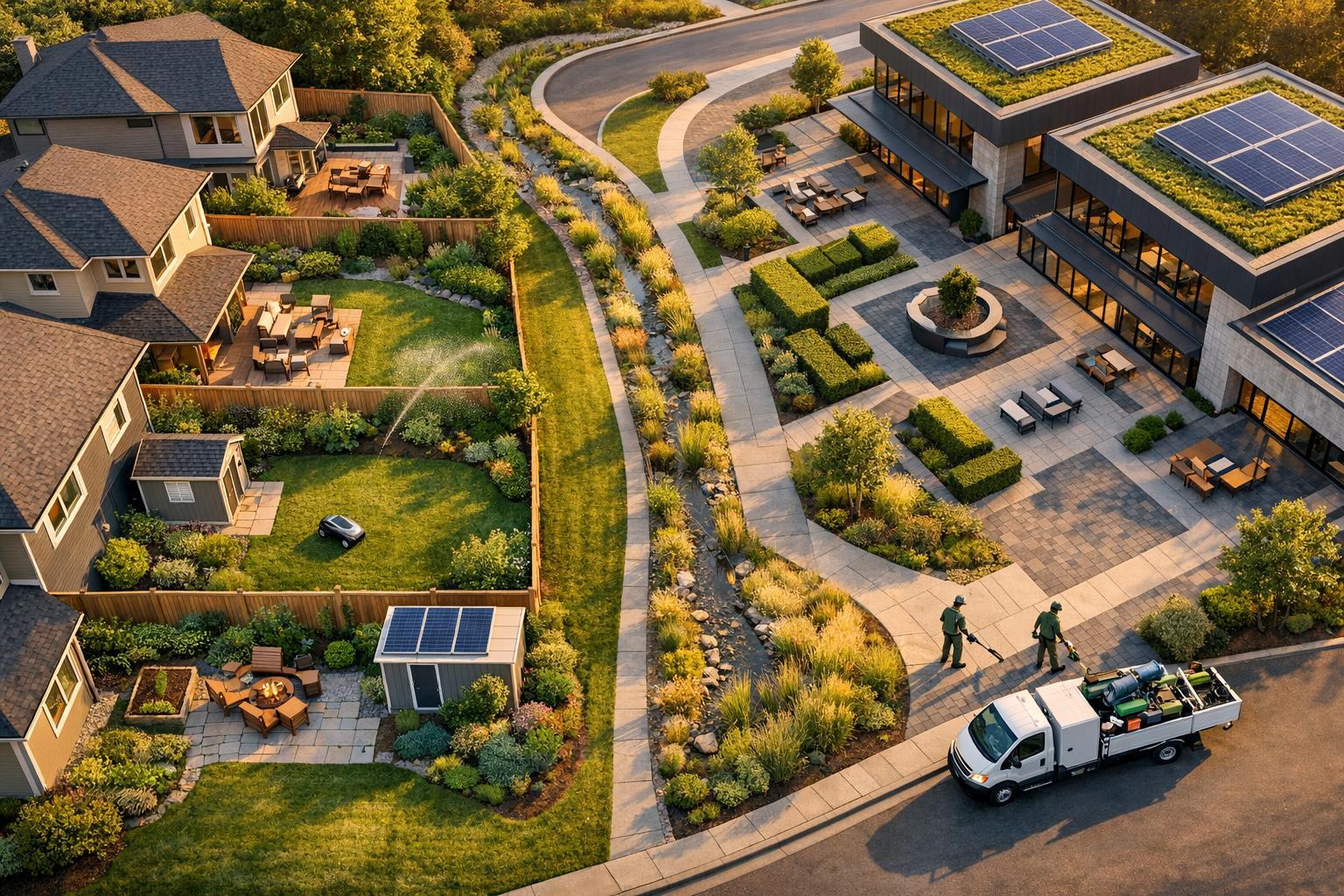
The landscaping industry in 2026 is booming, with the global market valued at $741.53 billion, growing at an annual rate of 10.8%. In the U.S., the sector generates nearly $200 billion annually, employing 1.3 million people across over 726,000 businesses. Homeowners increasingly view landscaping as an investment, with projects averaging $12,825 and monthly maintenance costs around $300. Key trends include:
- Outdoor living spaces: Features like outdoor kitchens, fire pits, and wellness zones are in high demand.
- Sustainability focus: Smart irrigation systems, drought-tolerant plants, and carbon-conscious materials are reshaping designs.
- Technology adoption: AI tools, robotic mowers, and automated systems (similar to how interior design AI apps are transforming indoor spaces) are addressing labor shortages and improving efficiency.
- Residential vs. commercial: Residential projects focus on aesthetics and value, while commercial landscaping emphasizes functionality and scale.
With costs rising due to labor shortages and material tariffs, the industry is embracing automation and eco-friendly solutions to meet growing demand. By 2030, the U.S. market is projected to reach $255.74 billion, driven by innovation and evolving homeowner priorities.

Landscaping Industry 2026: Market Size, Growth & Key Statistics
Landscaping Market Overview (2026)
Global and U.S. Market Size
By 2026, the global landscaping market reached a valuation of $362.16 billion, up from $344.78 billion in 2025. North America leads the industry, contributing roughly 34.6% to 36% of the global market share. Within this region, the United States is the key driver. In 2025, U.S. landscaping services were valued at approximately $188.8 billion, supporting nearly 1.5 million employees across 700,000 businesses. Projections suggest this figure will surpass $200 billion by 2030.
From 2020 to 2025, the industry experienced steady annual growth of 6.5%, fueled by a shift toward home-centric lifestyles and a growing emphasis on boosting property value. These trends highlight the diverse factors powering the market's expansion.
What's Driving Market Growth
Several trends are pushing the landscaping market forward. For instance, U.S. privately owned home completions rose by 5% in May 2023 compared to the previous year, spurring demand for landscaping installations. Additionally, 80% of homeowners expressed plans to maintain or increase their spending on garden care, viewing landscaping as a long-term investment in property value.
Environmental considerations are also playing a larger role. With climate patterns becoming more unpredictable - ranging from droughts to severe storms - property owners are increasingly adopting smart irrigation systems that adjust to real-time weather conditions. Rising municipal water rates further encourage the adoption of water-efficient landscaping solutions, which are both cost-effective and environmentally conscious.
Another major driver is the growing trend of expanding outdoor living spaces. Homeowners are transforming their yards into functional areas with features like outdoor kitchens, entertainment zones, and professionally designed gardens. This evolution has turned landscaping into a year-round priority rather than a seasonal task. Many companies have adapted by offering additional services such as snow removal and holiday lighting during the winter months.
How the Industry Is Divided
The landscaping market is divided by customer type and service offerings. Residential properties account for about 61% of total revenue, while commercial projects - like hotels, retail centers, and office parks - are gaining traction by focusing on curb appeal and property differentiation.
In terms of services, the market splits between routine maintenance (e.g., mowing, fertilization, pest control) and design/build projects (e.g., hardscaping, irrigation, new installations). Maintenance services dominate, with 48% of landscaping businesses citing them as their most profitable segment. Additionally, 32% of surveyed businesses identified maintenance as the fastest-growing service area.
This segmentation reflects how businesses are adapting their strategies. For example, in January 2025, Yellowstone Landscape partnered with Neuberger Berman Capital Solutions, which acquired a significant minority stake to fund commercial service expansion. Similarly, BrightView Holdings, Inc. launched a $100 million share repurchase program in March 2025 to solidify its leadership in U.S. commercial landscaping. These moves highlight how companies are positioning themselves to capitalize on emerging opportunities, shaping the current market landscape while setting the stage for future growth.
sbb-itb-4214aae
Market Size Projections (2024–2030)
Growth Rate and Market Expansion
The U.S. landscaping market is on track to hit $255.74 billion by 2031, growing at a 5.46% compound annual growth rate (CAGR) starting in 2026, up from $186 billion today. Specific segments like design-build and hardscape services are expected to grow even faster, with an annual growth rate of 8.35% through 2031.
Globally, the landscaping services market is also set for substantial growth. It’s projected to rise from $668.97 billion in 2025 to $741.53 billion in 2026, reflecting a 10.8% growth rate. By 2030, estimates suggest the global market could reach $1,123.53 billion, maintaining a 10.9% CAGR. However, alternate projections suggest a 2030 valuation of $484.79 billion with a 6.7% annual growth rate. These variations stem from differing ways of categorizing landscaping products and services.
In the U.S., advanced landscaping services - like smart irrigation systems and AI-powered design tools - are forecast to grow from $10.21 billion in 2024 to $13.54 billion by 2030, with a 4.82% CAGR. These numbers highlight the evolving landscape of the industry and the driving forces behind its expansion.
What's Fueling Market Growth
Several factors are driving these optimistic market projections, and they highlight how the landscaping industry is adapting to challenges and opportunities.
One major factor is the labor shortage. In 2025, landscaping contractors requested 97,000 H-2B seasonal visas but were granted fewer than 65,000, leaving a significant workforce gap. This shortage has accelerated investment in automation. For instance, AI-powered estimation tools have cut project quoting times by 65%, and robotic mowers are increasingly taking over routine tasks. These advancements alone are adding an estimated 0.7% to the industry's overall CAGR.
Environmental, Social, and Governance (ESG) compliance is another growth driver. Many corporate clients are retrofitting properties with drought-resistant landscapes to meet sustainability goals, contributing an additional 0.6% to growth rates. BrightView Holdings, for example, refinanced its $738 million senior secured term loan in February 2025, reducing its interest rate to Term SOFR plus 2.50%. This move freed up $3.7 million annually for reinvestment in eco-friendly services.
Finally, the rise of the subscription economy is reshaping the industry. Recurring lawn-care agreements now account for more than 75% of new residential bookings. This shift transforms landscaping from a one-time service into a predictable monthly expense, appealing to homeowners seeking budget stability and businesses prioritizing consistent cash flow. This model is not only stabilizing revenue streams but also accelerating market penetration across various sectors.
Landscaping Service Costs in 2026
Cost Breakdown by Service
By 2026, the average cost of a landscaping project in the U.S. is projected to be $12,825, with most homeowners spending between $3,300 and $13,200. Experts suggest allocating 5% to 10% of your home's total value for landscaping projects.
Hourly rates vary depending on the type of service. Mid-tier design-build companies typically charge $70 to $90 per man-hour, while specialized landscapers charge between $23.59 and $37.92 per hour. In the Southeast, irrigation repair services are priced higher, ranging from $95 to $135 per hour.
The size of the project also plays a big role in costs:
- Small front yards (under 500 sq. ft.): $2,000 to $5,000
- Medium backyards (500–1,500 sq. ft.): $5,000 to $15,000
- Large projects (over 1,500 sq. ft.): $15,000 to $50,000+
Specific installations come with their own price ranges. For instance, garden beds cost between $1,200 and $2,800, while retaining walls range from $4,000 to $9,000.
Maintenance services are a major part of the market, making up 52.2% of the overall landscaping industry. On average, U.S. homeowners spend $300 per month on landscaping upkeep, with professional monthly maintenance costs averaging $252 (ranging from $133 to $370). Additionally, annual irrigation maintenance plans can cost anywhere from $250 to $700, depending on the complexity of the system.
Costs are climbing at about 10% annually, driven by labor shortages and rising wages. Tariffs on imported materials and equipment are also contributing to higher prices for hardscaping and other specialized services. However, investing in professional landscaping can increase a property's resale value by up to 15%.
These pricing trends reflect broader industry shifts and local market conditions, setting the stage for a closer look at how regional factors further shape costs.
Regional Price Differences
Landscaping costs vary widely by location, influenced by factors like climate, soil quality, and access to materials. The South leads the market, holding a 37.8% share, thanks to its warmer climate, which supports year-round landscaping demand. In the West, xeriscaping is popular due to ongoing droughts, while the Northeast sees strong demand for seasonal services like snow removal and fall cleanup.
Soil conditions also play a role in pricing. For example, North Carolina's Piedmont clay increases labor costs for trenching, while poorly drained soils in Washington often require advanced drainage solutions like bioswales or rain gardens. In the Pacific Northwest, a basic low-maintenance yard starts at around $2,500, but hardscaping projects can cost between $7,000 and $15,000.
Material choices often reflect regional preferences. California projects frequently use locally sourced stone, while the Pacific Northwest leans toward native plants that require less water. A mid-size irrigation system in Greensboro, North Carolina, costs $5,500 to $8,500 and is designed for short, frequent watering cycles to suit clay soil. In Washington, systems focus on winterization and managing heavy rainfall with features like permeable pavers.
"A fair price on a vague plan is more expensive than a clear price on a precise plan." - Ramirez Landscaping & Lighting
Commercial landscaping operates on a different scale. Small office grounds (up to one acre) cost $2,000 to $8,000, while larger office parks (1–5 acres) range from $8,000 to $30,000. For industrial sites, landscaping costs can climb to $15,000 to $60,000, with annual maintenance budgets for commercial properties ranging from $3,000 to $15,000.
Residential vs. Commercial Landscaping
What Drives Demand in Each Sector
Residential and commercial landscaping cater to very different needs, shaped by distinct priorities and goals. Homeowners typically focus on improving curb appeal, creating inviting outdoor spaces for relaxation or entertainment, and boosting their property’s resale value. Popular features like patios, fire pits, and water installations often reflect a desire to extend their living space outdoors for personal enjoyment.
On the other hand, commercial landscaping is more about functionality and visual impact. Businesses use landscaping to attract customers, enhance their professional image, and meet regulatory requirements. For example, a well-maintained office park or retail area can create a welcoming atmosphere while ensuring compliance with rules around drainage, accessibility, and other site-specific mandates. These differences align with broader industry trends, where residential projects lean toward personalization, while commercial work emphasizes efficiency and practicality.
One thing both sectors have in common is the importance of maintenance. Nearly half of landscaping businesses (48%) report that services like mowing and lawn care are their most profitable offerings. In states like California and North Carolina, where droughts are a concern, both residential and commercial clients are increasingly adopting drought-tolerant plants and smart irrigation systems to manage water costs and adapt to unpredictable weather patterns.
Spending Patterns and Project Types
The contrast between residential and commercial landscaping becomes even clearer when you look at spending habits and project scales. Residential projects often focus on lifestyle enhancements, while commercial projects tend to operate on a larger scale, prioritizing functional upgrades over aesthetic luxuries.
For example, high-end residential projects can include features like elaborate water installations, retaining walls, or full yard makeovers, with costs often surpassing $50,000.
Commercial landscaping costs vary based on property size and purpose:
- Small office grounds (under one acre): $2,000 to $8,000
- Larger office parks (1–5 acres): $8,000 to $30,000
- Retail complexes: $10,000 to $50,000
- Industrial sites: $15,000 to $60,000, depending on site preparation and regulatory needs
Here’s a breakdown of typical costs for common project types:
| Project Type | Residential Cost Range | Commercial Cost Range |
|---|---|---|
| Lawn Installation | $2,000 – $4,500 | $1,200 – $2,800 |
| Hardscaping/Patios | $3,500 – $8,000 | $10,000 – $25,000 |
| Irrigation System | $3,000 – $8,000 | $3,000 – $8,000 |
| Full Renovation | $50,000+ | $15,000 – $50,000 |
| Annual Maintenance | $1,596 – $4,440 | $3,000 – $15,000 |
This comparison highlights how residential landscaping focuses on lifestyle and aesthetics, while commercial projects are driven by operational needs and scale. Each approach reflects the unique demands of its respective market, aligning with the broader industry patterns explored in this report.
Landscaping Trends in 2026
Environmental and Water-Saving Practices
By 2026, sustainability is no longer optional - it’s essential. Landscape professionals are prioritizing climate-resilient designs that focus on durability rather than fleeting aesthetics. This approach involves incorporating native and adaptive plants suited to local climates, as highlighted by Landscape America:
In 2026, resilience is not just an option, but a requirement.
Homeowners are increasingly moving away from traditional lawns. Turf reduction is on the rise, with many opting for low-maintenance plantings that need less water, fertilizer, and upkeep. In regions like California, xeriscaping has become a go-to strategy. This method uses drought-resistant plants and specialized designs to conserve water. Advanced irrigation systems are another game-changer. Weather-based controllers, for example, integrate real-time weather data and soil moisture sensors, cutting water use by 15% to 30%. Ramirez Landscaping & Lighting explains:
A weather-based controller with local-weather integration saves water in Greensboro's changeable summer... usually pays back within two or three summers via lowered water bills.
The shift toward sustainability also includes carbon-conscious materials and integrated pest management (IPM) to minimize chemical use. Electrified landscaping equipment is reducing both emissions and noise pollution. Additionally, permeable hardscaping materials are helping manage rainwater and reduce runoff, addressing both environmental and regulatory needs.
These eco-conscious practices are shaping a greener future while paving the way for technology to further transform the landscaping industry.
Smart Technology in Landscaping
Technology is reshaping landscaping like never before. By 2026, 78% of industry professionals are using AI tools, reducing design time by 70% and driving a 400% surge in AI landscape design searches between 2023 and 2025. Smart irrigation systems, adopted by 42% of households, are saving an average of 40% on water usage. These systems come equipped with flow sensors that detect leaks and shut off master valves to prevent water loss. As Nick Berger from Hidden Creek Landscaping, Inc. notes:
Clients like to be able to operate as much as possible through their phones for ease.
Other innovations include robotic mowers, which create smaller and more defined lawn areas, and advanced lighting solutions. Modern smart lighting is now 60% brighter and offers an extensive color palette - up to 50,000 shades. Dan Waters, owner of Creative Environments, shares:
The lighting is becoming smaller and more powerful. Some lighting that has just come out this year is 60% brighter with a range of colors. Instead of 10 colors, probably 50,000 colors.
These advancements in technology are seamlessly blending with design trends that reimagine outdoor spaces.
Outdoor Living Space Expansion
Outdoor areas are evolving into functional extensions of the home, featuring distinct zones for dining, lounging, and even working. Tyler Bigham from Alterra Landscape Design observes:
Homeowners are focusing on features that provide long-term value and low maintenance, like durable natural materials, efficient irrigation, and multi-functional outdoor spaces. They are more focused than ever on ROI.
There’s also a growing interest in intimate, personal spaces. Tara Piergies-Baker from The Addison Group predicts:
A very strong trend that I expect to really explode in 2026 to these small, intimate spaces. Think of words like nook... It's less of these big, huge, open, clean, hard spaces, and much more of a personal, comfy, intimate aesthetic.
Wellness features are becoming must-haves, including backyard saunas with Wi-Fi, cold plunge pools, and meditation zones. Outdoor kitchens are another hot trend. Dan Waters explains:
When you start building kitchen areas outdoors, there's a lot more that can be done. The list is 'I want a pizza oven. I want a side burner. I want refrigerators. I want an ice maker...' Outdoor kitchens are becoming very important to a lot of people.
Homeowners are also embracing three-season rooms, complete with covered cabanas, pergolas, and efficient heating. These spaces allow for outdoor enjoyment even in colder months. Together, these trends are transforming landscapes into versatile, year-round living areas, driving growth in both residential and commercial landscaping markets.
Top 2026 Garden Trends | Monrovia’s Design Insights for the Year Ahead
25 Landscaping Statistics for 2026
Here’s a detailed look at the numbers shaping the landscaping industry in 2026, covering market trends, consumer habits, and the role of technology.
Market Size and Growth
- Global market value: The landscaping services market hit $741.53 billion in 2026, up from $668.97 billion in 2025.
- Annual growth rate: The sector grew at a 10.8% compound annual growth rate (CAGR) from 2025 to 2026.
- U.S. market size: The domestic market reached a valuation of $156.6 billion in 2025.
- U.S. growth trajectory: The American market is on track for a 5.09% CAGR through 2034.
- Global projection: By 2030, the global landscaping market is forecasted to reach $1.12 trillion, with a CAGR of 10.9%.
- U.S. business count: Over 726,000 landscaping businesses operate in the U.S., employing approximately 1.3 million people.
- Annual U.S. revenue: Landscaping generates nearly $200 billion in revenue annually within the U.S..
Service Distribution and Market Share
- Maintenance services: Maintenance dominates U.S. landscaping, holding a 52.2% market share.
- Commercial vs. residential: Commercial landscaping accounts for 58.7% of the U.S. market.
- Residential landscaping: Residential services have reached 65% market penetration in the U.S..
- Regional leader: The Southern U.S. leads with a 37.8% market share.
- Top service: 48% of landscaping businesses cite landscape and mowing maintenance as their most profitable service.
- Commercial maintenance revenue: Maintenance services bring in 83% of revenue for contractors surveyed, highlighting their importance.
Consumer Spending and Project Costs
- Average project cost: Landscaping projects in the U.S. average $12,825.
- Monthly maintenance spending: Homeowners spend about $300 per month on landscaping services.
- Household spending increase: Average U.S. household spending on lawn care rose to $616 in 2022, up from $542 in 2021.
- Future spending plans: 42.8% of homeowners plan to increase their landscaping and gardening budgets in 2026.
- Premium preferences: 77% of homeowners are willing to pay extra for specific plant varieties or flower colors.
- Garden expansion: 63.6% of gardeners intend to expand their gardens in 2026.
- Time investment: Homeowners dedicate about 70 hours annually to lawn maintenance.
Technology and Efficiency
- Water conservation: Smart irrigation systems can reduce water usage by 50% compared to traditional methods.
- Labor cost savings: Automated technology users report labor cost reductions of 15–20% within a year.
- Long-term savings: Integrated automation systems can deliver up to 30% savings over five years.
- Software adoption: 62% of commercial landscaping companies use seven or more software tools.
- Wage growth: 70% of commercial landscaping companies plan to increase wages in 2026, with 44% expecting raises of 4% or more.
These figures highlight the industry’s push toward innovation, efficiency, and broader service offerings, paving the way for a deeper dive into the technologies transforming landscaping.
Technology in Landscaping
Technology is reshaping the landscaping industry, simplifying tasks like site surveys, grading, and client presentations. This frees up professionals to focus on creativity and innovation. Designers now use tools like tablets to close deals on-site, while automation helps address labor shortages expected in 2025. The conversation has shifted from wondering if technology fits into the workflow to figuring out where it delivers the most value. This shift is driving advancements in AI-powered design and automated maintenance.
AI and 3D Design Tools
Generative design software, such as TestFit, is transforming the design process. It automates calculations for parking, zoning, and green space ratios, allowing designers to create multiple iterations in just minutes. Tools like Autodesk Forma take it a step further by simulating environmental factors like wind, sunlight, and noise. These insights help optimize plant placement and create comfortable spaces for people.
AI tools also speed up project approvals and improve visual presentations. Platforms like Rendair AI can turn simple sketches or CAD screenshots into lifelike 4K images in seconds. This capability is a game-changer for securing HOA approvals and winning over clients who need to see a clear vision before committing.
"The question is no longer if artificial intelligence fits into the workflow, but where it creates the most leverage."
LiDAR apps like Polycam and AR tools are also making waves. They generate precise 3D site surveys and overlay digital elements in real time, helping to shorten sales cycles.
The impact of these tools is evident. For example, in 2025, Tom Teehan of Solomon Services secured three projects worth $63,100 within three days of using PRO Landscape design software. Similarly, Kerry Stinnet of Lawn Tek Landscaping used a tablet-based design app during a client meeting to create a visual concept in minutes. The result? An immediate deposit and same-day project scheduling.
"I took my iPad to estimate a job for a customer who couldn't visualize anything. It just took a few minutes to create a design and she was blown away! 5 minutes later I had a deposit." - Kerry Stinnet, Lawn Tek Landscaping
Automated Maintenance Equipment
Technology isn't just improving design; it's also revolutionizing maintenance. Automation has become essential rather than optional. Robotic and autonomous mowers now make up about 15% of the powered lawn mower market, while mowers with integrated smart technology account for roughly 25%.
The push toward electric-powered autonomous equipment has gained momentum. In mid-2023, Greenworks Tools introduced a smart lawn mower with IoT features for remote control and monitoring. Shortly after, Toro launched a battery-powered mower with an advanced system to reduce charging time and boost efficiency. Husqvarna Group followed in September 2023 by acquiring a robotics company to expand its automated lawn mowing systems. Honda Power Equipment joined the trend in October 2023 with new electric mowers featuring extended battery life and energy optimization.
Smart irrigation systems have also seen major advancements. IoT-enabled sensors now monitor soil moisture and plant health in real time, enabling automated watering schedules that can cut water usage by 15% to 30%. Flow sensing technology adds another layer of efficiency by detecting leaks or broken components and shutting off master valves to prevent water waste and property damage.
Connectivity is another key feature. Many tools now offer app-based interfaces and telemetry, letting managers track fleet performance and optimize routes remotely. These systems can even integrate with smart home platforms, making property management seamless for both residential and commercial clients.
"Even autonomous mowers are gaining popularity among landscaping business owners, particularly with the industry facing protracted labor shortages." - Michael Finati, LandPro Program Manager
Automation is especially beneficial for larger operations, delivering significant savings on labor costs.
| Technology Type | Market Share / Impact | Primary Benefit |
|---|---|---|
| Robotic Mowers | 15% Market Share | Reduces manual labor requirements |
| Smart Tech Integration | 25% Market Share | Enhanced convenience and telemetry |
| Smart Irrigation | High Growth | Water conservation and plant health monitoring |
| AI & 3D Modeling | High Growth | Improved design accuracy and client visualization |
This growing adoption of technology reflects a broader transformation in the industry. Landscaping companies are integrating digital tools to boost both design and operational efficiency. Similar trends are visible in related fields, such as interior design, where AI-powered visualization tools are changing how professionals approach spatial planning. The edge now belongs to businesses that can quickly adapt and streamline operations, rather than relying on larger workforces.
The Future of Landscaping Through 2030
By 2030, the landscaping industry will undergo significant changes, driven by environmental policies, technological advancements, and expanding markets. The global landscaping services market is projected to grow to $484.79 billion, while the U.S. sector specializing in tech-driven and eco-conscious solutions is expected to reach $13.54 billion. This growth reflects a shift toward sustainable, tailored services that align with new regulations and shifting consumer priorities.
Water conservation and biodiversity will take center stage in landscaping standards. Governments are increasingly requiring urban developments to include green spaces like parks, gardens, and green roofs to improve biodiversity and urban resilience. For instance, the World Resources Institute updated its UrbanShift initiative in January 2024, emphasizing these elements as solutions to mitigate extreme heat and pollution. These changes are pushing the industry to embrace practices like xeriscaping, native plant landscaping, and the use of permeable pavers as standard offerings, aligning with the broader movement toward eco-friendly designs and smart irrigation systems.
Technology will revolutionize efficiency and profitability. As discussed earlier, advancements in automation and AI are set to redefine operations. AI-driven tools could increase cash flow by over 120% by 2030, while automation might boost profit margins from the current 5% to as much as 25%. For example, drone technology is already replacing time-intensive manual tasks, dramatically speeding up project timelines.
"Contractors must prepare now to adopt AI and robotic solutions to remain viable and competitive. These will simply be the tools the modern contractor uses." - Our Code World
However, even with these technological leaps, the industry will still need skilled workers. Labor shortages are expected to persist, particularly for roles requiring expertise in advanced eco-friendly systems and complex installations. To stay ahead, businesses must integrate smart irrigation systems, AI-driven design tools, and automated maintenance solutions, which can help offset workforce challenges while meeting evolving market demands.
FAQs
Why do the global market size numbers differ in this report?
Differences in global market size figures often stem from the diversity in data sources, methodologies, and scope used in reports. Some estimates might focus on particular sectors, such as residential landscaping versus commercial landscaping, while others may include varying services like maintenance, design, or installation. Geographic emphasis, differences in cost structures, and the timeframes of data collection also play a role in shaping these numbers. These factors are crucial to keep in mind when analyzing and comparing figures from different reports.
What landscaping upgrades give the best ROI in 2026?
A well-maintained, lush lawn can offer an impressive return on investment - over 200%, to be exact. Beyond that, adding carefully planned curb appeal features can enhance a home's value by as much as 20%. These upgrades not only elevate property aesthetics but also play a major role in attracting buyers and boosting overall market value.
How can homeowners reduce long-term landscaping costs?
Homeowners looking to save on landscaping expenses over time should focus on smart planning and sustainable options. Choosing low-maintenance plants, sturdy materials, and water-efficient irrigation systems can help cut down on both upkeep and water bills. Tackling simple DIY tasks like pruning and mulching can reduce the need for paid labor, and keeping up with regular maintenance can help avoid expensive repairs. A well-thought-out design combined with consistent care is essential for keeping long-term landscaping costs in check.