
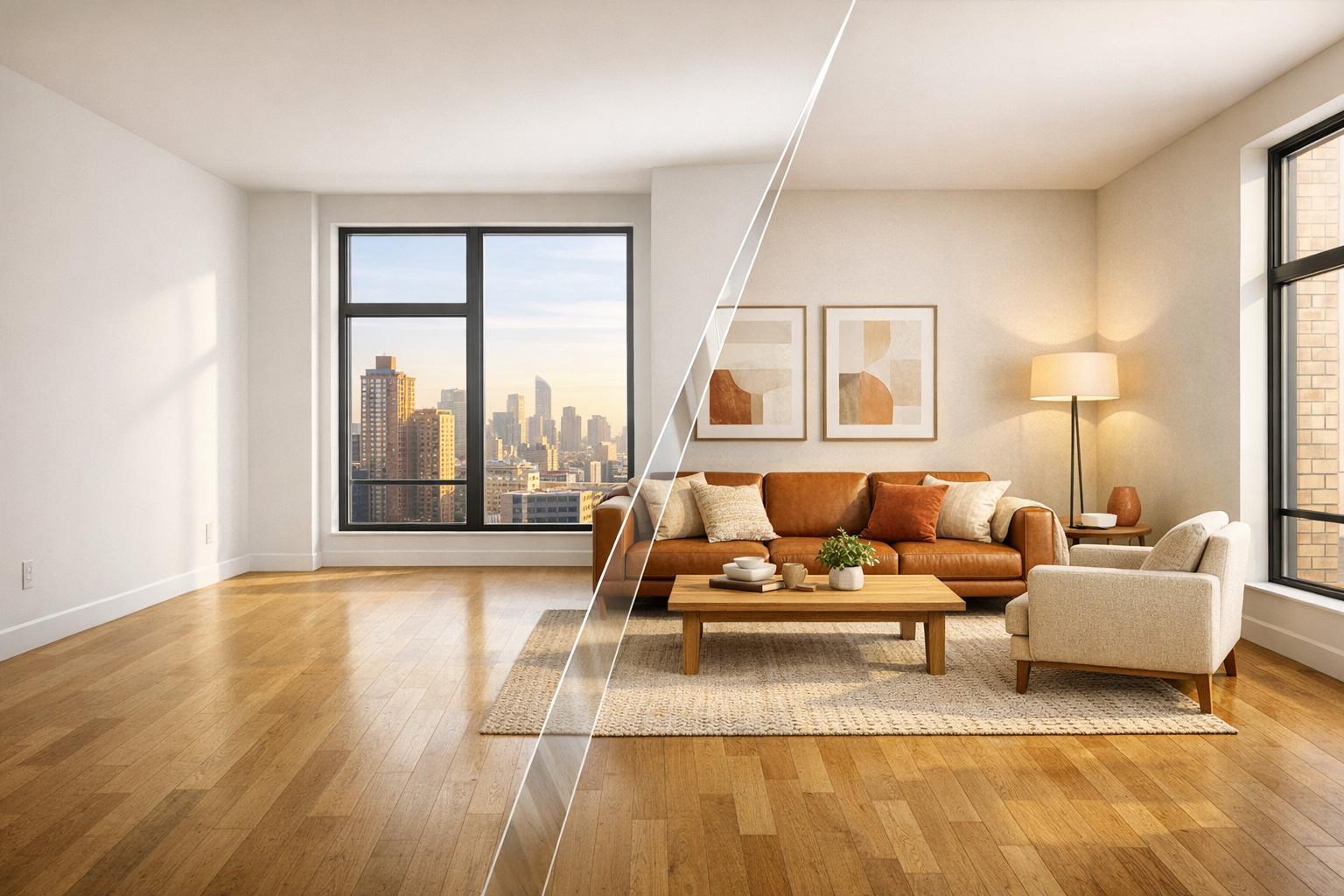
Virtual staging is transforming real estate marketing in 2026. Here's what you need to know:
- Market Growth: The virtual staging market grew to $1.33 billion in 2026, with projections reaching $10.8 billion by 2033.
- Cost Efficiency: Virtual staging costs 95%–99% less than physical staging, with AI services starting at just $1–$15 per photo.
- Faster Sales: Staged homes sell 73% faster, reducing time on the market from 52 days to 29–31 days.
- Higher Prices: Virtually staged homes achieve 98.5%–99% of asking prices, compared to 96%–97% for unstaged properties.
- Engagement Boost: Staged listings see a 90% increase in click-through rates and 70% more time spent on listing pages.
With 96% of buyers starting their search online, virtual staging is now a go-to tool for real estate agents to save money, sell faster, and boost property appeal.

Virtual Staging Statistics 2026: Market Size, Costs, ROI and Performance Metrics
Virtual Staging Market Size Statistics
Global Market Value and Growth Rate
The global virtual staging market saw its value climb from $1.22 billion in 2025 to $1.33 billion in 2026. Projections for the market's future size vary depending on the methods and scope used:
- Expected to reach $2.96 billion by 2032, with a CAGR of 13.51% from 2026 to 2032.
- Another forecast estimates $10.8 billion by 2033, with a CAGR of 18.7% from 2025 to 2033.
- A CAGR of 26.5% is projected through 2031.
Cloud-based solutions dominate the market, holding 72% of the share, thanks to their affordability and scalability. Among end users, real estate agents are the top segment, accounting for 55% of market usage. Meanwhile, AI virtual staging for images remains the most popular solution type, making up over 60% of the market.
Regional trends highlight the varying dynamics shaping the market worldwide.
Market Performance by Region
North America currently leads the global market, holding a 45% share, valued at $945 million in 2024. Within North America, the United States contributed to over 60% of virtual staging platform subscriptions in 2023. This leadership is driven by factors like frequent residential property sales, early adoption of proptech, and advanced digital infrastructure.
The Asia-Pacific region is predicted to grow the fastest, with a CAGR of 22.3% through 2033. This rapid growth is fueled by urbanization in countries like China, India, and Southeast Asia, combined with smart city projects supported by local governments.
In Europe, the market was valued at $504 million in 2024. Western European nations are increasingly adopting hybrid deployment models to ensure compliance with data protection regulations such as GDPR.
| Region | 2024 Market Size | 2033 Projected Size |
|---|---|---|
| North America | $945 million | $4.86 billion |
| Europe | $504 million | $2.59 billion |
| Asia Pacific | $420 million | $2.16 billion |
| Latin America | $126 million | $648 million |
| Middle East & Africa | $105 million | $540 million |
sbb-itb-4214aae
Virtual Staging Cost Statistics
Average Cost Per Room
Virtual staging has become an affordable and fast alternative to traditional methods, with costs depending largely on the technology used. AI virtual staging is the most budget-friendly option, ranging from $5 to $15 per photo, while manual virtual staging costs significantly more, at $25 to $75 per photo. This highlights the price advantage of AI tools over manual editing. These tools can produce virtual staging before and after examples that rival professional photography.
For a typical 3-bedroom home requiring five photos, AI staging costs between $25 and $75 per listing, compared to $125 to $600 for manual services. The average price of professional virtual staging platforms has also dropped, from $35–$50 per image to $15–$30 between 2024 and 2025, driven by growing competition among AI providers. Some AI tools have pushed prices even lower, offering services for as little as $0.24 to $1.00 per photo.
Another key advantage of AI staging is speed. While AI-generated images can be ready in under 30 seconds, manual editing typically requires 24 to 48 hours.
Cost Comparison: Virtual vs. Physical Staging
When compared to virtual staging, physical staging is far more expensive. Professional physical staging typically costs between $2,000 and $5,000 for the initial setup. On top of that, furniture rental adds recurring fees of $500 to $1,500 per room, per month. In contrast, virtual staging is 95%–99% cheaper than traditional physical staging methods.
The median cost for physical staging has risen sharply, from $400 in 2019 to $1,500 in 2025. For high-volume real estate agents, switching to virtual staging offers potential savings of over $50,000 annually.
| Listing Type | AI Virtual Staging | Manual Virtual Staging | Physical Staging |
|---|---|---|---|
| Studio / 1-Bed (3 photos) | $15 | $75–$225 | $1,500–$2,500 |
| 3-Bedroom Home (5 photos) | $25 | $125–$375 | $3,000–$5,000 |
| 5-Bedroom Luxury (10 photos) | $50 | $250–$750 | $5,000–$10,000 |
"At $5/photo for AI virtual staging, the investment is zero-risk. For 95% of listings, virtual staging delivers comparable online impact at 1/100th the cost of physical staging." - RoomStage ROI Guide
The drastic cost savings associated with virtual staging not only reduce expenses but also enhance return on investment, as explored in later sections.
Real Estate Marketing and Listing Performance Statistics
Listing Views and Engagement Rates
Virtual staging plays a key role in boosting online property engagement. Listings with virtual staging achieve a thumbnail click-through rate (CTR) of 3.5%–4.5%, compared to just 1.8%–2.2% for empty room listings - an increase of nearly 90%. This is a big deal because many real estate portals use engagement metrics, like CTR, to determine search rankings. Essentially, better engagement translates to more visibility for staged listings.
Buyers also spend more time on staged listings. The average time spent on a listing page jumps by 70%, from 27 seconds for empty rooms to 45–60 seconds for staged ones. This extended engagement leads to better results: staged properties generate a viewing request every 35 views, compared to 1 in 60 for unstaged listings - a 70% improvement.
Photos are critical in the decision-making process. A whopping 82% of U.S. buyers say property photos are the most important factor, and 77%–81% of buyers admit that staged images help them imagine living in the space. On the agent side, 68% of real estate agents report that virtual staging improves their success rate when pitching to potential sellers.
These improved engagement metrics don’t just look good - they help speed up the sales process.
Days on Market
Virtual staging significantly shortens the time properties stay on the market. On average, staged homes sell 73% faster than unstaged ones, with some reports suggesting they sell up to 88% faster. Specifically, virtually staged properties spend around 29–31 days on the market, compared to 52 days for unstaged listings - a reduction of about 40%–60%.
This quicker turnaround isn’t just about convenience - it saves money. Reducing time on the market by just 15 days can save sellers between $1,050 and $1,950 in carrying costs like mortgage payments, taxes, and utilities. For real estate agents, faster sales mean they can manage more listings at once and allocate their marketing budgets more effectively.
| Metric | Empty Room Listings | Virtually Staged Listings | Relative Change |
|---|---|---|---|
| Thumbnail Click-Through Rate (CTR) | 1.8%–2.2% | 3.5%–4.5% | ↑ ~90% |
| Average Time on Listing Page | 27 seconds | 45–60 seconds | ↑ ~70% |
| Enquiry / Viewing Request Rate | 1 in 60 views | 1 in 35 views | ↑ ~70% |
| Median Days on Market | 52 days | 29–31 days | ↓ ~40–60% |
For a deeper dive, check out the State of Virtual Staging in 2026 report.
AI Interior Design and PropTech Adoption Statistics
Real Estate Industry Adoption Rates
AI-powered virtual staging has shifted from being an experimental tool to becoming a regular part of the real estate process in the U.S. Today, over 50% of real estate agents incorporate virtual staging into their listing strategies. By 2025, this practice is expected to be labeled as "highly important" by 16%–18% of agents.
Currently, 68% of agents believe virtual staging enhances their ability to win instructions when pitching to potential sellers. The technology’s speed is a game-changer - AI tools can now stage empty rooms in less than 30 seconds. Platforms using generative AI also report a 44% faster turnaround for property listings.
"Virtual staging is no longer optional - it's a competitive necessity." - Staging Wizard
These trends highlight the increasing reliance on PropTech solutions to enhance virtual staging capabilities.
PropTech Integration Trends
As AI-powered virtual staging becomes more common, the industry is integrating these tools into broader PropTech ecosystems. Cloud-based SaaS platforms dominate, making up 72% of the market due to their scalability and ease of use on mobile devices. This allows agents to stage properties directly on-site, removing the need to rely solely on desktop systems.
The push for comprehensive visualization tools is evident. For example, in July 2023, Matterport acquired VHT Studios to combine professional virtual staging with its 3D digital twin technology. Similarly, BoxBrownie.com introduced a real-time virtual staging preview tool in late 2023, which attracted over 20,000 users in its first quarter.
Augmented reality (AR), automated floor plans, and 3D tours are rapidly becoming standard features [15,16]. New AR tools even allow buyers to overlay digital furniture onto live camera feeds during in-person walkthroughs. With 96% of buyers starting their property search online, these digital-first tools are now critical for effective property marketing.
Virtual Staging ROI and Property Sale Impact
Impact on Sale Prices
Virtually staged homes consistently outperform their unstaged counterparts, achieving 98.5%–99% of their asking price, compared to 96%–97% for unstaged properties. This difference translates to a 2%–3% increase in final sale value. For instance, on a $350,000 home, a 2% price boost equals an additional $7,000 in revenue.
Real estate agents report that 20% of staged properties receive 1%–5% higher offers, while 13% see increases of 6%–10%. For a $400,000 home, even a modest 1% price bump adds $4,000 - resulting in an impressive 15,900% ROI.
Beyond higher sale prices, virtual staging also enhances online performance. Listings with virtual staging experience a 90% increase in click-through rates and a 70% rise in viewing requests. Furthermore, 81% of buyers say staging helps them imagine the property as their future home, often leading to stronger offers.
These price advantages pair seamlessly with the time-saving benefits discussed below.
Time to Sale
When it comes to selling faster, virtually staged properties shine. They typically spend 29 to 31 days on the market, compared to 52 days for unstaged homes - a reduction of approximately 40%–60%. This performance nearly matches that of physically staged homes, which sell in an average of 28 days. Overall, staged homes sell 73% faster than their unstaged counterparts.
Faster sales also mean reduced carrying costs. For every 15 days shaved off the market, sellers save between $1,050 and $1,950 in expenses. For those juggling dual mortgages or needing to relocate quickly, these savings can be just as valuable as the increased sale price.
| Metric | Empty Room | Virtually Staged | Physically Staged |
|---|---|---|---|
| Median Days on Market | 52 days | 29–31 days | 28 days |
| Achieved Price vs. Asking | 96%–97% | 98.5%–99% | 99%+ |
| Typical Cost | $0 | $6–$30 | $2,000+ |
| ROI Percentage | N/A | 15,900%–116,000% | ~100%–300% |
For more detailed findings, check out the State of Virtual Staging in 2026: Market Size, AI Trends, Costs, and Industry Statistics report.
25–40 Virtual Staging Statistics for 2026
Here are some standout numbers from the State of Virtual Staging in 2026 report, covering market size, costs, ROI, and industry trends:
- $1.33 billion – Projected global virtual staging market size in 2026, increasing from $1.22 billion in 2025.
- 13.51% – Estimated Compound Annual Growth Rate (CAGR) for the virtual staging industry from 2026 to 2032.
- 26.5% – An alternative CAGR projection through 2031.
- 95% – Virtual staging costs are 95% lower than physical staging.
- $1–$15 – Average cost per image for AI-based virtual staging services in 2026.
- $25–$75 – Price range per image for manually created virtual staging by professionals.
- $2,000–$5,000+ – Typical upfront costs for physical staging per property.
- $500–$1,500 – Monthly furniture rental expenses for physical staging per room.
- 90% – Increase in thumbnail click-through rates for virtually staged listings versus empty room photos (3.5–4.5% compared to 1.8–2.2%).
- 70% – Boost in time spent on a listing page with virtual staging (45–60 seconds compared to 27 seconds).
- 96% – Percentage of homebuyers starting their property search online, underscoring the importance of digital visuals.
- 16–18% – Real estate agents who consider virtual staging a "highly important" tool in 2025–2026, compared to 0% before 2023.
- 21% – Agents staging all listings physically in 2025, down from 37% in 2017 due to rising costs.
- 81% – Buyers who believe staging helps them imagine a property as their future home.
- $7,000 – Additional revenue from a 2% price increase on a $350,000 home using virtual staging.
- 116,000% – Potential ROI from a $6 investment (6 AI images) resulting in $7,000+ in extra property value.
- $1,050–$1,950 – Savings in carrying costs for every 15 days shaved off time on market.
- Under 60 seconds – Time it takes for AI-powered virtual staging to produce images, much faster than manual methods.
- 3–10 days – Setup time typically required for physical staging.
These figures provide a clear glimpse into the virtual staging market. For more detailed insights, check out the full State of Virtual Staging in 2026 report.
Key Takeaways
For a detailed analysis, check out the State of Virtual Staging in 2026: Market Size, AI Trends, Costs, and Industry Statistics report.
- Market Growth: Virtual staging has become essential in 2026, with the global market valued at $1.33 billion. It's expected to grow at a rate of 13.51%–26.5% CAGR through 2031–2032.
- Online Buyer Behavior: A staggering 96% of homebuyers now begin their property search online, making high-quality digital visuals more important than ever.
- Cost Savings: Virtual staging costs range from $1–$15 per image, compared to $2,000–$5,000+ for traditional staging. This represents a 95% reduction in costs and an ROI that can exceed 1,000%, with some cases reaching up to 15,900%.
- Higher Sale Prices: Homes with virtual staging sell for 2%–3% more, adding around $7,000 in value on a $350,000 property.
- Better Performance: Virtually staged listings get 90% more clicks and sell 73% faster, cutting down market time by 40%–60% (from 52 days to about 29–31 days).
- Time Savings: Reducing market time by 15 days can save sellers between $1,050 and $1,950 in carrying costs.
- Agent Trends: Around 16%–18% of real estate agents now consider virtual staging a top priority, while the use of physical staging has dropped from 37% to 21% since 2017.
- Buyer Appeal: 81% of buyers say staging helps them picture a property as their future home.
These highlights showcase how virtual staging is reshaping the real estate landscape and driving success in the market.
FAQs
Which listings benefit most from virtual staging?
Virtual staging works wonders for listings that could use a boost in visual appeal - especially vacant or unfurnished properties. By adding virtual furniture and decor, these listings tend to grab more attention online, see higher click-through rates, and even sell faster.
How do I choose between AI and manual virtual staging?
Choosing between AI and manual virtual staging comes down to what matters most to you. AI staging is a faster option, taking just about 30 seconds per photo, and it's budget-friendly, with prices ranging from $5 to $15 per photo. This makes it a great choice if you need something quick and scalable. On the other hand, manual staging is more expensive, costing between $25 and $75 per photo, and requires more time - typically 24 to 48 hours. However, it delivers highly detailed and tailored designs, which are perfect for showcasing high-end properties. Think about your budget, timeline, and the level of design detail you need before deciding.
Are virtually staged photos required to be disclosed in listings?
Yes, listings must disclose virtually staged photos according to FTC and MLS policies. These guidelines promote transparency by requiring sellers to clearly state when images have been digitally edited to change a property's appearance.