
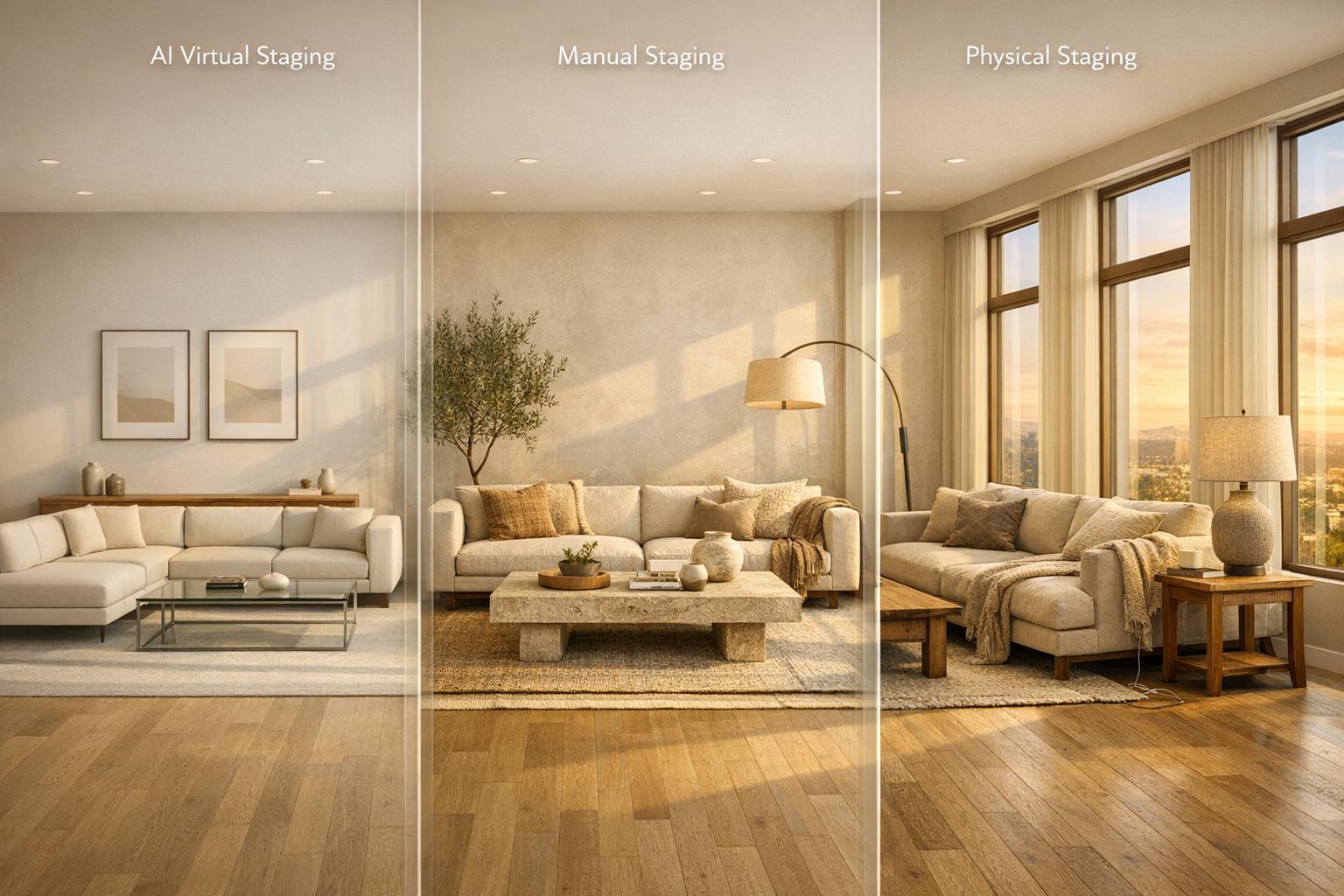
Virtual staging transforms property photos by digitally adding furniture and design elements (see these virtual staging before and after examples), helping buyers visualize spaces. For large real estate projects, AI-driven staging is faster, cheaper, and more scalable than manual methods. Here's a quick breakdown:
- AI Staging: Costs $0.27–$2.67 per image, delivers results in seconds, and can handle bulk processing with consistency.
- Manual Staging: Costs $24–$100 per image, takes 24–72 hours per photo, and offers detailed customization but is labor-intensive.
- Physical Staging: Costs $1,000–$5,000 per property and requires significant logistics and time.
AI staging is ideal for high-volume projects due to its speed and affordability, while manual staging works best for high-end or unique properties requiring a personal touch. For example, staging 300 images with AI costs $150 and takes one day, compared to $7,200 and weeks with manual methods.
Quick Comparison:
| Metric | AI Staging | Manual Staging | Physical Staging |
|---|---|---|---|
| Cost per Image | $0.27–$2.67 | $24–$100 | $1,000–$5,000 (per property) |
| Time per Image | Seconds to minutes | 24–72 hours | 3–21 days (setup) |
| Scalability | Unlimited | Limited by labor | Limited by logistics |
| Customization | Moderate | High | Moderate |
For developers or agents managing multiple properties, AI staging offers unmatched efficiency. A hybrid approach - using AI for most listings and manual staging for luxury properties - can balance speed with precision.

AI vs Manual vs Physical Virtual Staging Comparison: Cost, Time and Scalability
AI vs. Manual Virtual Staging: Direct Comparison
Comparison Table: Key Metrics
When comparing AI and manual staging, the differences in performance metrics become strikingly clear.
| Metric | AI Virtual Staging | Manual/Designer-Led Staging |
|---|---|---|
| Production Time | Seconds to under 5 minutes | 24–48 hours |
| Cost per Image | $0.27–$2.67 | $16–$24 |
| Scalability | Unlimited via automation | Limited by human labor |
| Skill Requirements | Low (upload and select style) | High (professional design/3D skills) |
| Visual Consistency | High (consistent across projects) | Variable (depends on designer) |
| Revisions | Instant and often free | 24–48 hours, sometimes extra cost |
For instance, AI platforms can charge as little as $0.27 per image when purchased in bulk, whereas manual staging services typically cost around $24 per image. If you’re working with 200 images, AI staging would cost approximately $54, while manual staging could set you back about $4,800. This stark contrast highlights the practicality of AI for large-scale projects.
Strengths and Weaknesses of Each Method
While numbers offer a clear snapshot, the qualitative strengths and challenges of each approach paint a fuller picture.
AI staging thrives on speed and efficiency. As explored in our AI Interior Design Blog, It allows users to experiment with various design styles in mere seconds. Seamless integration with tools like Slack, Dropbox, and Google Drive further simplifies workflows for high-volume projects. That said, AI can falter when dealing with unconventional room layouts or intricate architectural elements that demand a human touch.
Manual staging shines in customization. Professional designers can tailor every detail to fit unique architectural nuances or appeal to specific buyer profiles. This approach provides unmatched creative flexibility, ensuring cohesive visuals across different angles of a space. However, this level of detail comes at a cost - manual staging can be 6 to 89 times more expensive per image and requires a turnaround time of 24–48 hours.
"AI virtual staging excels at handling a high volume of images quickly. This makes it ideal for real estate agents or property management companies with numerous listings." - Styldod
Some agencies opt for a hybrid model: leveraging AI for the majority of listings to save time and money, while reserving manual staging for luxury properties priced over $2 million, where precision and attention to detail are paramount. This strategy balances efficiency with the need for high-quality customization in premium markets.
sbb-itb-4214aae
How AI Virtual Staging Benefits Large Projects
Automation and Speed
AI tools streamline the staging process by cutting out the manual work that often bogs down large projects. Instead of coordinating multiple steps, you just upload photos and receive realistic, staged images in under five minutes. This kind of efficiency enables entire portfolios to be staged in just one day. Plus, AI offers instant design revisions - something that would take days with traditional methods.
For large-scale projects, this speed means you can experiment with different styles - like Modern, Coastal, or Scandinavian - to see which one gets better engagement on listing platforms. A great example: a Manchester estate agency staged ten new-build flats for about $1.30 per photo (converted from £1). Within 24 hours, the listings were live, portal views doubled, and five flats were reserved within ten days. The total staging cost? Just $78 (converted from £60).
This kind of rapid turnaround not only saves time but also significantly reduces costs.
Lower Costs for High-Volume Projects
The cost advantage of AI staging becomes even more apparent when dealing with high volumes. Traditional staging can cost between $2,800 and $9,000+ per property for a three-month listing. In contrast, AI can stage a three-bedroom home for as little as $1.50 to $4.00. For brokerages handling 20 listings a month, this translates to monthly savings of $55,961 to $179,961.
Platforms like InstantInterior AI take this a step further with subscription-based pricing. Their Business plan, for example, provides 24,000 credits upfront (enough for 2,000 renders per month) at $49.50 per month when billed annually. This brings the cost per render down to just $0.025. The plan also includes features like commercial usage rights, ultra-high-resolution images, and priority support - key benefits for agencies managing large portfolios.
Here’s another example: a Charlotte agent restaged a $425,000 property with eight room photos for a total cost of $2.16. The process took about 10 minutes. The result? Online views jumped by 40%, and the home sold 11 days later for $431,000 - $6,000 above the asking price.
Customization and Flexibility
AI staging isn’t just about speed and cost - it also offers unmatched design flexibility. Modern platforms come with extensive design libraries, featuring a wide array of styles and thousands of furniture options to cater to different buyer preferences. For instance, InstantInterior AI allows agencies to customize designs based on style references, inspiration images, or even text prompts. You can tweak details like wall colors, furniture, and room layouts while keeping full control over design versions.
This flexibility also makes it easy to create multiple design options simultaneously. Imagine staging one version of a home with a sleek, minimalist look for younger buyers and another with a more traditional feel for families. You can then use online metrics to see which design performs better. Unlike physical staging, AI allows for A/B testing of different styles at the same time. For developers managing multi-unit projects, this means tailoring each unit’s design to specific market segments without adding significant costs or delays.
AI Staging Just Got Better
Manual Virtual Staging for Large Projects
While manual staging delivers unmatched artistic detail, it struggles to keep pace with large-scale projects, especially when compared to AI-driven solutions.
Custom Design for Specific Spaces
Human designers excel at creating tailored, visually stunning designs. They carefully adjust furniture placement, lighting, and layouts to complement unique architectural features. Beyond basic staging, manual methods can handle intricate tasks like removing existing items, updating layouts, and even transforming images into twilight scenes. Designers also weave in a layer of storytelling, aligning their work with buyer demographics and local preferences to craft spaces that resonate emotionally.
"Professional virtual staging is the smarter choice for high-value or architecturally unique properties. These listings demand more than speed - they require the trained eye of a human designer." - VirtualStaging.com
However, achieving this level of customization requires significant time and financial investment.
Labor Requirements and Costs
While manual staging offers design advantages, its labor-intensive nature poses challenges for large projects. Costs can range from $24 to $100 per photo, with expenses increasing proportionally as the project grows. Unlike AI, which can process countless images simultaneously, manual staging is limited by the capacity of individual designers.
Unforeseen costs are another hurdle. In 2025, agents frequently faced budget overruns due to multiple revisions and rush fees, with some projects doubling in cost. A survey from the same year revealed that 67% of agents using manual staging paid rush fees averaging $267 per listing, and 89% required an average of 2.3 revisions per room. These delays and added expenses stand in stark contrast to AI solutions, which can stage entire portfolios in a single day without extra fees for revisions.
Cost and Time Analysis for Large-Scale Projects
Example: Staging 50+ Properties
When scaling up, the cost difference between AI staging and traditional methods becomes hard to ignore. For instance, staging 300 images across 50 properties using AI costs just $80 to $150 per month. Compare that to manual virtual staging, which ranges from $7,200 to $22,500, or physical staging, which can skyrocket to $75,000–$200,000 or more.
The time savings are just as striking. AI platforms can process all 300 images in less than a day, often delivering results in minutes per image. Manual virtual staging, on the other hand, takes two to seven days per property, meaning it could take weeks to finish staging a portfolio of 50 properties. Physical staging is even slower, requiring three to ten days per property just for setup - not to mention the added time for logistics.
Here’s a real-world example: A property management firm with 50 vacant units needed marketing materials within 72 hours for a launch. Using AI staging, they completed all 300 images in one business day at a cost of $150. If they had opted for manual staging, it would have taken weeks and cost at least $7,200, making their tight deadline impossible to meet.
These numbers highlight the scalability challenges of traditional methods compared to AI.
Scalability Considerations
Beyond cost and speed, scalability introduces even more hurdles for manual staging. Designer-led services are constrained by the number of available personnel, while physical staging requires extensive warehouse inventory, transportation logistics, and insurance. As one industry expert put it:
"An agency with 50 active listings can virtually stage them all in a day. Doing that physically would require a warehouse of stock and a full-time logistics team."
AI platforms, however, rely on automation rather than labor. Enterprise users benefit from volume discounts, reducing costs to just $0.24–$0.50 per image, compared to $24.00–$75.00 per image for manual services. Revisions further widen the gap. AI tools regenerate designs instantly at no extra charge, while manual services typically charge $89 per room for revisions and add rush fees ranging from $150 to $400.
A 2025 survey revealed that 89% of agents using manual staging needed an average of 2.3 revisions per room, pushing final costs well beyond initial estimates. This underscores how AI can deliver consistent results at a fraction of the cost and time required by traditional methods.
Using InstantInterior AI for High-Volume Virtual Staging

Key Features of InstantInterior AI
InstantInterior AI takes virtual staging to the next level by automating large-scale projects with impressive speed and precision. The platform can generate realistic staged rooms in just 60 seconds, making it 100 times faster than traditional manual staging methods. This means entire property portfolios can be staged in mere hours instead of taking weeks.
With over 40 professional staging styles - ranging from Modern and Scandinavian to Industrial and Luxury - users can cater to diverse design preferences. The platform also allows custom inspiration images, enabling tailored aesthetics for specific client needs. Every render is delivered in high resolution, free of watermarks, and optimized for MLS listings and print materials.
Another standout feature is the ability to make unlimited revisions at no extra cost, available with paid plans. This flexibility ensures users can refine designs until they align perfectly with their vision. As the platform highlights:
"Our AI understands room proportions, lighting, and design principles to create photorealistic staged rooms".
These capabilities empower users to deliver professional, cost-effective staging at scale.
Pricing Plans for Large Projects
InstantInterior AI offers flexible pricing options to suit different needs, whether for small portfolios or large-scale operations. Here’s a breakdown:
- Hobby Plan ($13.50/month): Includes 1,200 credits, enough for about 100 renders per month, ideal for smaller projects.
- Premium Plan ($28.50/month): Provides 7,200 credits for 600 renders monthly, along with priority support - perfect for mid-sized agencies.
- Business Plan ($49.50/month): Offers 24,000 credits, allowing for approximately 2,000 renders per month at just $0.10 per render. This plan is tailored for agencies managing extensive portfolios.
All paid plans come with commercial usage rights, ultra-high-resolution images, and advanced editing tools, such as wall painting and room emptying. This pricing structure makes it easier for agencies to scale their staging efforts without breaking the bank.
How InstantInterior AI Streamlines Large-Scale Staging
InstantInterior AI simplifies the staging process into three straightforward steps: upload room photos, choose a design style, and generate staged images. This eliminates the need for coordinating with furniture vendors or relying on in-depth design expertise.
Real estate agent Pierre shared his experience:
"I'm experiencing a remarkable boost in lead generation, attributed to enhanced photos in my listings. These improvements have effectively addressed issues where potential clients struggled with visualizing the space".
For agencies managing dozens of properties, these benefits are amplified. While traditional staging might take days - or even weeks - per property, InstantInterior AI enables users to stage multiple properties in a single day. Additionally, built-in AI photo enhancement tools handle tasks like adjusting lighting, sharpening resolution, and decluttering spaces, cutting down on post-processing time.
Conclusion: Choosing the Right Staging Method
Key Takeaways
When deciding between AI and manual virtual staging, factors like project volume, property value, and turnaround time play a crucial role. AI staging shines when speed and scalability are priorities. It can produce photorealistic room renders in seconds, offering dramatic cost savings. This makes it an excellent option for high-volume portfolios, rental properties, and homes priced between $300,000 and $800,000.
On the other hand, manual staging is better suited for luxury properties exceeding $800,000 or spaces with unique architectural features. Human designers excel in creating precise furniture arrangements and achieving a polished aesthetic. However, the cost difference between these methods is stark - AI staging is far more affordable on a per-image basis compared to professional manual staging.
Turnaround time is another major factor. AI staging provides nearly instant results, while manual staging typically requires at least 24 hours. For agencies handling 20+ listings per month, the speed of AI staging can significantly reduce time-to-market and holding costs. These considerations lead to a clear set of recommendations.
Final Recommendation
Given its speed and cost advantages, AI staging is the go-to solution for high-volume projects. Platforms like InstantInterior AI offer AI interior designs with enterprise-level pricing as low as $0.10 per image, making them highly practical for large-scale real estate needs. The affordability and efficiency of AI staging are increasingly rendering manual methods less viable for extensive portfolios.
That said, a hybrid approach can also work well. Use AI for quick staging of standard listings, and reserve manual staging for high-end or flagship properties where customization is essential. With 97% of buyers starting their search online, prioritizing speed and visual appeal in digital listings is key to maximizing impact. Just make sure to include "virtually staged" disclosures to maintain transparency with potential buyers.
FAQs
When should I choose manual staging over AI staging?
Manual staging shines when consistency, customization, and craftsmanship are at the forefront. It allows for a unified design that looks great from every angle and can be personalized to suit the specific character of a property. For luxury homes, intricate layouts, or situations requiring a refined, highly tailored look, manual staging delivers a level of detail and artistry that AI tools often struggle to match.
How accurate are AI-staged images for unusual layouts?
AI-generated images for unconventional layouts often face hurdles in maintaining both consistency and realism. Unique angles or out-of-the-box designs can make it tricky for the technology to deliver accurate and cohesive results, which may affect the overall dependability of the staging in these scenarios.
Do I have to disclose virtual staging in listings?
Virtual staging doesn’t require disclosure in listings, as long as it’s clearly labeled that the images are digitally staged. Since it’s a marketing tool and doesn’t involve any physical alterations to the property, it’s not considered misleading. That said, openly sharing this information helps build trust with potential buyers and ensures transparency.